
Creative Entrepreneurship: Everything We Make Is Art with Catherine Just - EP 059
Nov 13, 2025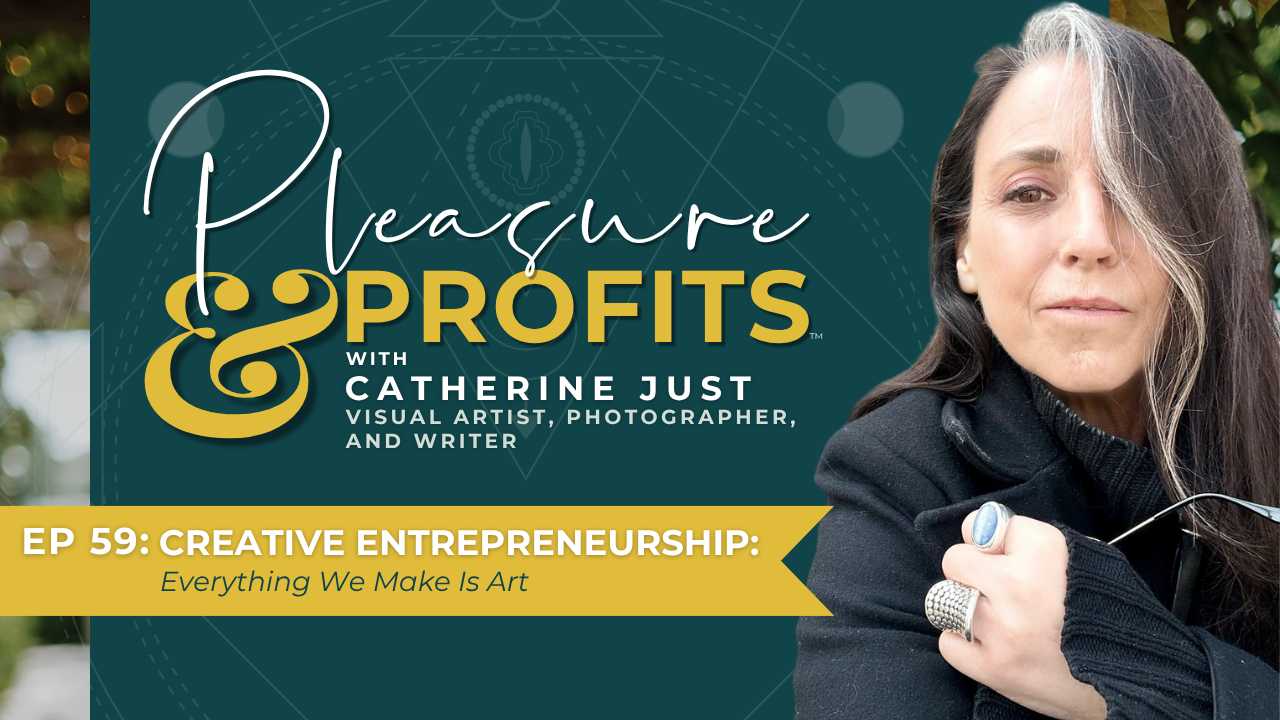
Listen on Spotify | Apple Podcasts | iHeartRadio | Pandora | Amazon Music
Are you ready to trust yourself more deeply through your creative process?
In this episode, I sit down with visual artist Catherine Just to explore what it truly means to live as a creative entrepreneur. Catherine shares her journey of healing through art and how creativity shapes not just what we make, but how we live and lead. We talk about embracing creativity as a daily practice, navigating the balance between artistic passion and practical business demands, and learning to trust your inner voice along the way. This conversation is a reminder that everything we create—from our art to our business—is an expression of who we are.
This episode is an invitation to reconnect with your inner artist, release self-judgment, and honor your creative legacy as a gift to others and to yourself.
Episode Takeaways:
- Creativity and entrepreneurship are deeply connected expressions of who we are.
- Art can be a pathway for healing, growth, and transformation.
- Viewing creativity as a practice helps you move past perfectionism.
- Trusting yourself is essential to building a sustainable creative business.
- Every act of creation contributes to your legacy and impacts others.
Key Insights:
"We are making art all the time in our decision making. It's like a brush stroke, and we can paint over it if we feel like it with a different color. But if we see that this whole thing is a creative practice and process, it changes everything. It's such a beautiful thing to decide in every moment that you are in creation. You are a creator. What is it that you're making today?"
"Sit down and with your vision that's bigger than you think is possible, write it as if it's happened and it was easy. Then take one tiny baby action towards that future that brings it closer to the now. Those two things combined create an opportunity for the universe to swoop. Your subconscious is getting a memo and it's putting it in a file and then … you actually start becoming it."
Resources Mentioned:
Connect with Catherine:
- Instagram: @cjust
- Website: catherinejust.com
Connect With Me:
- Email: [email protected]
- Instagram: @RachelAnzalone
- Facebook: Rachel.Anzalone
- LinkedIn: RachelAnzalone
Question for Your Reflection:
What legacy do you want your creativity and entrepreneurship to leave behind?
Did this episode resonate with you? Share it with another visionary leader who needs to hear this message, and don't forget to subscribe and leave a review. Your support helps other impact-driven entrepreneurs find their way to our community.
Remember: Your pleasure is your power. 💫
Ready to step into the pleasure revolution and transform how you do business? Let's explore how to maximize impact, profit, and pleasure in alignment with the new paradigm. Schedule a time to connect with me right here >>>
Episode Transcript
Catherine Just: (00:00.086)
And if I can catch myself and move back into my heart, into my body, there is a hum there. The hum is where the truth lives. It's not in that. And then it doesn't matter. I really have to say that again. It really doesn't matter. And that's when things start to come. Or effortlessly. Or we learn something from nothing coming and we can just adjust without taking it personally.
Rachel Anzalone: (00:37.038)
Hello and welcome to Pleasure and Profits. I'm your host, Rachel Anzalone. And my guest today is a really incredible woman that I feel so honored to have been able to have this conversation with and spend this time with. My guest today is Catherine. Catherine is a visual artist, a photographer, and a writer living in Los Angeles. With 38 years of sobriety from a meth addiction and a personal apprenticeship with Miguel Ruiz, author of The Four Agreements, her creative path is rooted in healing and transformation.
Her work has been published on the cover of National Geographic Magazine, in O Magazine, and shown internationally, including London, Milan, and Paris. Catherine's fine artwork explores the unseen emotional terrain inside love, loss, and what lives in between them. Her photo sessions, called Capturing Breath on Film, invite women to belong more fully to themselves.
Catherine teaches courses and offers mentoring online. She leads retreats in France and co-creates projects with her son Max, who has Down Syndrome. I loved my conversation with Catherine so much. We covered so many topics from creativity to entrepreneurship and everything in between. And I feel so honored to have had this conversation and I'm thrilled to share it with you. I hope you enjoy it as much as I did.
Welcome to Pleasure and Profits. Catherine, I'm so excited for you to be here as a guest with me today. As I was saying before we started recording, when I was planning out my year of content and I decided that I wanted to explore this topic of the relationship between creativity and entrepreneurship, and I thought about who I would want to talk to, you were at the top of the list. And that was almost a year ago, so I'm very excited that we're actually getting to talk now.
Catherine Just: (02:14)
Well, I'm honored to hear that. I'm so grateful to be here. Thank you for inviting me.
Rachel Anzalone: (02:23.886)
Thank you. I'm such a fan of your work and I for a long time, I think I was introduced to you probably in the, I want to say maybe like 2010, 2011 maybe seeing your photos of Danielle Laporte and and Carrie M. Moss for Annapurna Living and just how beautiful they were and have sort of been following along since then.
So one of the things I think that really stands out about your work is how you weave together this healing work and transformation and your artistic expression. And then of course, in the context of running a business and being an entrepreneur as well and all the things that go along with that. To get us started, would you share a little bit about what your evolution has been through your healing journey and your own sort of transformational process in your work?
Catherine Just: (03:19)
Yes, that's a great question. Well, I mean to go all the way back to the beginning, in high school I did art because I had to take it to graduate and that teacher told me I had talent and it was the first time that anybody during that time period in my life was giving me attention and telling me I was good at something. And I think she saved my life because at that time I was addicted to meth and super uncomfortable being here on the planet and uncomfortable in my own skin.
And all of a sudden I had a thing to focus on. I had a person who was loving even though she knew what I was doing. And so when I hit my bottom after I graduated high school and asked to go to treatment and got sober at 18, I went to art school because I didn't know what else to do. And I'm so grateful I had that.
But that was the kicker. That's like where it started. And then I went to art school and studied conceptual photography, film and video. And it broke my brain that I could take a feeling or an idea or a conversation and turn it into something visual. And I'm still turned on by that today. And I graduated college in 1992. It's been this lifelong curiosity inside my recovery to take the things that are underneath the surface that we don't necessarily want to say out loud inside relationship, or that I don't have the words yet to articulate, or that I'm in just so much pain, I'm just ruminating about it or in it. I can funnel all that stuff into my artwork and create a type of visual poetry around it. It's just become a part of my practice now.
And then, I studied with Miguel Ruiz, who wrote The Four Agreements, and learning from him cracked it open even more. And I'm still in love with the practice of waking up and recognizing that 98% of the reason why I suffer is because of what I'm thinking. Ouch. And to learn how to take responsibility in every single moment that I have a choice. But all of that I also, I just weave it into, I can't not. I can't not weave that into the classes I teach and my own work and my investigating relationship through this practice of art making.
Rachel Anzalone: (05:48)
I love how you're referring to it as a practice versus a product, which I think is a really important distinction of making something as a product, like to sell versus making something as a practice of expression or a practice of, yeah, I mean, maybe expression's the only word, but of like sort of bringing what's inside of you out.
Catherine Just (06:03)
Yeah, I actually went to art school without a plan. It was just what I liked to do and the only thing I knew to do. And so while people were learning about business, I was like, that's not why I'm here. I like literally was not available for it. I was more interested in the practice and the process of investigation and creation. And then over time, I made this my career.
And then I needed to learn all the things that come with it. And I feel like a lifelong learner around the business aspect, around the creative aspect, all of it, and the spiritual thing. Like I just feel in love with learning how to awaken, like I've said, yeah, using the tools in my business and in my creative practice and in my relationships.
All of it. I have learned and continue to learn about marketing and creating something that maybe someone wants. So that's, that's like after the fact. It's not like I make work for people.
Rachel Anzalone (07:16)
Yeah, you're making me, well, two things that I'm thinking of and one I'll share in a second. I have a book sitting here next to me I wanted to share something from. But you're also making me think of some conversation I've heard Elizabeth Gilbert say about like your, oh gosh, I'm forgetting the word. It's your craft, your art versus your hobby versus your job versus your career.
And sort of her story of like, she says she was a writer always before she ever got paid for it. She was a writer for 20 some years. And then it was like, then I got paid a little bit. So it was sort of like, a little bit, it was a job. It was like how I got to be, how I paid my bills. And then at some point it became my vocation of like, this is my life's work. And how that's so contradictory to the way that so many of us are taught, particularly when you're going to college, it's like go do the thing that you're gonna go have a job and a career at, right? Yeah.
Catherine Just (08:22)
Yeah, yeah,
Yeah, I didn't. I was still very rebellious around authority in general and people telling me what to do.
Rachel Anzalone (08:30)
Yeah.
Catherine Just (08:31)
I wasn't available for it. I was available to make my work and to get comfortable in my skin. That's all really that mattered to me. I couldn't really look people in the eyes yet or hold conversations that were meaningful yet. It was all very uncomfortable. I was like prickly skinned in front of people and by myself. So that all of that came second. But yeah, I feel and I hear people and it breaks my heart a bit to hear this. But when people come to my classes and say, I'm not an artist and tell me why not or they have a teacher from the past that told them not to pursue it and I don't have that problem. I don't relate to that. I know in my bones I'm a creative human and I use different mediums based on what's happening. I don't limit myself to photography. It's really about being honest in my creative practice by opening the doorways to however it needs to come through me.
But I think that's, yeah, like I said, it's heartbreaking to hear the lie that people think they aren't creative. So I just don't, I don't believe it.
Rachel Anzalone (09:43)
Yeah, I think we all are, right? And so it's like, what's the channel that you are creating through? What is it that, what's your expression in the world?
You said something in the class that I took from you online, which was around, I actually, don't remember exactly what the topic was. I just remember that it was like, it was really about tapping into your creativity, I think was sort of the essence of it.
And you said something in that class that really stuck with me, which is, well, backstory. I also went to art school. That's where I started my college career. And I remember just feeling like I need to be good at this, right? I need to be good at this. Am I good enough at this? Am I good enough at this to make a living? Sort of all those pieces. And not really feeling it myself, like the freedom to just like do it for the sake of doing it as a creative expression, like it needed to be good.
And, you know, ultimately left art school and did many other things over the years. But that sort of creativity and that artistic expression is sort of part of everything they've always done. But for me, it was like, I had this story in my head that like, well, that's fine if it's a hobby then because it's not the thing you're going to make a living at, right?
And so you said on the class, you said something about doing it just for the sake of doing it and not needing to be good. it just clicked in that moment that I had spent, like that that was the thing that prevented me from going all in on it was this idea that I had in my head that it had to be good and it couldn't just be a tool of expression.
And then realizing even as an adult having taken some art classes being like, I'm not enjoying this because the teacher is teaching it in a way that it's like, here's how you do the thing and I just want to be in a room with music and paper and a pen. I want to be having an experience, not trying to draw correctly in the way that you're teaching us how to draw.
Catherine Just (11:53)
Yep. Yes.
That reminds me, I failed a life drawing class. I couldn't, I couldn't. It wasn't my thing. And it was embarrassing for sure. But yeah. Yeah.
That is so typical too of like trying to be good and we're taught that like and what is good like where did come from and all of us have a different measure of excellence or image of perfection that we're trying to reach and nobody has the same one. So how do we ever get to good? I don't. And then if we get somewhere and get some feedback about it, then there's always another carrot in front of that that we're trying to reach like we never really let ourselves feel the goodness of our creativity.
Rachel Anzalone (12:31)
Right. Yeah.
Catherine Just (12:45)
There's always some measuring system happening.
Rachel Anzalone (12:48)
And so what's interesting and where I feel like the parallel is in a lot of the intersection of this is that I think the same is true for anything that we create that is of our innermost desires and feelings. And for so many of the people that I know, and I think probably that you know too, because I think we kind of run in similar circles, it's like my work in the world is my creative expression. It is who I am. It is like my purpose and I have such a massive impact that I want to have in the world. I think that's a common theme.
And then feeling constrained by like, it good enough? Am I doing the things the right way? Am I following the way this person taught me is how you do business or how you market or all of those things that often just get in our way.
Catherine Just (13:41)
Yeah, I find that paralyzing and I have that conversation. I think all of us have that conversation going on. It's the, what Miguel Ruiz would call the dream of the planet. And I think that we get it hooked by what we're telling ourselves and what we're getting fed from social media and all the classes and all the books.
And I think that when we can, I mean, I have the experience of tuning into the truth here that has nothing to do with any story or mechanism outside myself. It actually doesn't matter. And then we trust that the right people are going to find us. Like peace is crucial for me to get out of paralysis. Because I do, I do dip into that. I was there today.
Going to rep my email and making a sales page and I teach people that it's a living breathing thing. Our work is a living breathing thing and we are always changing. So it doesn't have to be perfect. I can change my mind tomorrow about what I say in my sales page or what the email, who am I trying to impress? Who are those people? If I truly just love myself no matter what, and trust that the right people are going to see it and do the work to like be seen. You know, but get out of the results and stop trying to control the outcome. I think that I have a much better experience of having a business that's creative and is very vulnerable. It's like I am my brand.
So it is personal, but also I get to practice detaching from how other people feel about it. How do I feel about it? And can I, I will seek out validation from my peeps. What about this? What about this? What about that? And I, and if I can catch myself and move back into my heart into my body, there is a hum there. The hum is where the truth lives. It's not in the... in that. I... and then it doesn't matter. I really have to say that again. Like, it really doesn't matter. And that's when things start to come. More effortlessly. Or we learn something from nothing coming and we can just adjust without taking it personally. Sound like something?
Rachel Anzalone (15:51)
So where do you find the, how do you determine where the line is between, I need to like lean in and learn something here because I'm stepping into a realm that I don't have knowledge or skills in versus like, I'm just gonna follow my intuition and guidance. Like for example, you said like the drawing class that you failed, right? Like foundational art school, everybody has to learn, you know, the basic drawing, figure drawing, color theory, sort of like all the basic things.
And we might not all be good at each of those things, right? But we still need to have an understanding of them in some way in order to know whether that's a thing that we want to lean into or not. And so if you put that in the context of entrepreneurship in your business, how do you decide where you're like, I know enough to follow my intuition or I need to invest in like learning something here because I don't.
Catherine Just (17:02)
Yeah, that's such a good question. The difference between taking a life drawing class where there are naked people sitting on a chair. I'm so embarrassed, you know, I can't look and allowing myself to be the person that doesn't need to go back to prove anything. I don't need to go back and prove anything. That's just not comfortable in my body. Now it'd be fine. Now I'm a different person, but I really honored that about myself and didn't try to make up for that and force myself to sit there and look at a naked person being so uncomfortable. No.
With business, I learned by watching. And I'm constantly making mistakes and learning from them or like putting something out there, not knowing everything. And everybody's saying like, you need Kajabi, you need a MailChimp, you need, it needs to look like this. You need to make videos. You need to have a funnel. You need to, and I'm like, I've never had a funnel. I've never used Kajabi. Like everything's still on my website. I'm still using zoom. I'm still just using the things that I understand because the content is the most important thing to me. Not the way it looks necessary. I mean, yes. It is important how it looks to me as an artist.
But it doesn't need to, I don't have to spend a lot of money because all these other people are saying this platform and this email and this funnel and I don't know how and I don't really want to spend my time. And it was already working, so why do I need to shift because all the other people are doing that? I just know what's working and it's still very basic.
That's just… That's just been for me being honest again with not needing to fix something that's not broken. And now I'm, and because I have to say like I was very much struggling and still do with ADHD. And so learning all that, all that stuff was overwhelming and I'd get paralyzed by it too. I'm like, no, I, this is working. I have to keep it super simple. And just knowing that about myself helps me move forward with the work I'm here to do rather than shutting down because I don't understand MailChimp or something. I know if that makes sense, but...
Rachel Anzalone (19:31)
Yeah, it does.
And it's a thing I hear. I have coached many people through the process of figuring out like they have a vision of what they think they want their business to be based on what they see other people doing and then make themselves so uncomfortable trying to get to it. And I'm not anti, I mean, I'm not anti being uncomfortable. Like we should push our boundaries and challenge ourselves, but like contorting yourself to try to fit into this thing that's like, that doesn't, that's not for you.
And then you lose track of the work that you actually wanted to be doing because you're so focused on building the business and you know, all of the systems and the team and the things to get to, you know, whatever that looks like. And very often I think for, for creatives, it's that, you know, that sort of vision of like the financial success that in order to hit it they would have to have a business that's completely different than the business that they have, right? And be managing a team and sort of all these things. It's like not what you wanna do. You don't wanna have a team of 35 people in order to build a $10 million business or, you know.
Catherine Just (20:36)
Yeah. No, no.
And I just hired somebody. I don't have a team. I have one person that I'm just now starting to release some of the work so that I can focus more on making art than the customer relations emails and videos to people. Like all of those things. I'm really good at it.
And also, it's not a useful use of my time. It's not an effective use of my time. So that's different, I think, than trying to look a certain way.
Rachel Anzalone (21:17)
Yeah.
Catherine Just (21:20)
Yeah, I think that you can get washed, you can get like, I'm losing my train of thought.
Rachel Anzalone (21:26)
It happens over here all the time. Sometimes mid-word.
Catherine Just (21:45)
I was just thinking that. I find that there's a group of us that are all fine art photographers. We're all women fine art photographers in Los Angeles.
And I'm the only one that leads retreats, teaches classes online, does photo sessions and shows my fine art. And they're looking and I, and I'm posting on social media, like I'm having a love affair with it. Like I really and I am, and they're looking at me like, that's not right. You are, you're spreading yourself too thin. You need to focus on one thing. And, and, and I think I would feel like I should then get an office job.
Rachel Anzalone (22:14)
Hmm.
Catherine Just (22:15)
I wouldn't be expressing my full expression. I wouldn't be able to create the way who I am naturally, if somebody who listens to my entire being. If I stop doing photo shoots, I feel like something is missing. If I'm not teaching, I feel like part of my purpose is missing. And I've tried to niche down and listen to those people. It felt awful, for me. And just to stand firm in the knowing of who I am and what I need.
And also, I just want to say this other thing that also happens when we seek out, myself included, a mentor that we look up to to get feedback about our business and also about my work. And I've had several who have conflicting feedback for me about my work.
And then it, I can no longer defer or you know look outside myself to know if my work is good or not. It comes back then to me really checking in with myself and trusting that this path, I'm gonna choose this path even though this person over here who I really admire and look up to is saying this other thing. It is really about continuing to have a relationship with myself and trusting over and over and over and over.
Rachel Anzalone (23:36)
Yeah.
Catherine Just (23:39)
You know, and seeking help, can't, I don't think I can move forward without mentoring or not working in a vacuum. That's a terrible place to be for me.
Rachel Anzalone (23:40)
Yeah, it sounds like all of those things contribute to your own growth and your own creative expression is like to be able to have those interactions with people and to be sharing the things, like teaching the things that you're learning and integrating. And that fills you up and nurtures you, which is very different than being like, you know, you're doing your fine art and you're teaching, I don't know, you're like doing something completely unrelated or something that's actually pulling your attention away because you feel like you have to do that versus, you know.
Catherine Just (24:29)
Yeah, yeah,
It's all interconnected. There's a through line here. Yeah, for sure. And I feel like it's a harder road.
Rachel Anzalone (24:33)
In what way?
Catherine Just (24:44)
Because I am splitting my focus. So even online, on my social media feed, you'll see I'm teaching a class and then the next day I'm talking about going to New York with my art and then the next day I'm talking about a photo shoot. Like, who am I? Like people aren't.
Rachel Anzalone (25:02)
It's so funny because I don't, that doesn't feel contradictory to me at all. I think it makes perfect sense because I actually have, I've had this conversation with a lot of people recently who transitioned from doing things in person, like where they were interacting with people to during the pandemic years, going online and just teaching to them feeling like, I don't, I feel out of integrity because I'm not actually doing the work anymore. Now I'm just teaching. And so feeling like I need to be doing the work some, and I want to be teaching some, some of that can be online, but some of it needs to be in person. And I also need to be going and doing my own healing work. Like all of that feeds in.
Catherine Just (25:34)
Right.
Yeah. And that's where it gets a little tricky for me because I am split focused and I refuse to not be. But I do have a need to teach, but sometimes it gets way out of balance and I'm not making my art. And then I feel a little resentful.
Rachel Anzalone (25:56)
Yeah.
And then it's time to adjust. Yeah.
Catherine Just (26:08)
Yeah, but then I see where my upper limits are and like why I'm not actually focusing on my art is because I'm not trusting in myself. Like I just made the best work of my life over there. I don't know if I have anything else. I might be, I might be done here. Like that initial starting something is, is it can be paralyzing for sure. So I'll just like fill the time with helping other people. I've done that a lot. So that's now shifting big time.
Rachel Anzalone (26:14)
Yeah.
Catherine Just (26:39)
Which, go ahead.
Rachel Anzalone (26:39)
What are, you talked a lot about trusting yourself. What are the practices that you use to listen and to learn to trust yourself more and more?
Catherine Just (26:46)
I think it is an ongoing practice of noticing when I am leaking my energy outward and I do it. I'm like, what do you think? What do you think? What do you think? I was doing it this morning with the sales page. Is this the tagline or is that the tagline? And like two different words. And that was causing suffering because I wasn't listening. I had to just break the… disrupt that pattern that I have to like believing that I don't know that can just swoop right in and I don't even realize I'm doing it. So it is about awareness. Everything is about awareness for me. That's the key to everything if I don't have awareness I can't change it.
I'm very aware that I can get hooked by my thoughts about not enoughness or too muchness or they're better than me, I might as well quit. Like all the things that I teach other people how to move through. It really is coming down to paying attention all the time to what my thoughts are saying and choosing if I really want to go down that road. And sometimes I do. Sometimes I just want to hang out and inhale. And until I'm done, not judge myself for that, but really it is, it is meditation. It is writing in my journal all these things to become very present with the me that doesn't have a story attached to it.
And that old story of me recognizing that's not even real in the now, it's not a thing I can just read and be. This is ongoing minute by minute, practice of awareness and then shifting contrary actions disrupting a pattern being still drinking water doing all the things that we kind of know do and sometimes I do them and sometimes I don't.
Rachel Anzalone (28:40)
Yeah.
It is interesting, particularly with the online environment that we have right now, where it's just like more and more more info about what we should be doing and we could be doing that even in the extent of the wellness practices, then it's like, here's like 500 other things you should be doing in your wellness practice. And then that can become like, this thing you're listening to 20 different people telling you all the things you need to be doing there. And so…
Catherine Just (28:57)
Yeah.
Rachel Anzalone (29:17)
But like, you know, coming back to the business stuff of, always tell people you can, whatever I say to you, I guarantee you can find like 20 other people who are going to give you, tell you something different and there's no right or wrong. You mostly need to pick one and stick with it. Stick with it as long as until you're like feeling it out, maybe does this feel right? Does it not? It doesn't. Okay, then you go to the next thing. But when you're like, maybe this, maybe this, and you're sort of all over the place. In that sense, you don't really get to see the results, you don't get to see the impact of the work that you're doing because your energy is just dispersed in all of these things instead of really learning to listen to yourself.
Catherine Just (30:03)
Yeah, I really like what you just said about, you know, trusting in one maybe business philosophy and trying it and seeing if it works or not. And there's no good or bad or right or wrong. That's the thing. And we have so much. And I actually really like listening to Chase Darvis and Rich Roll and Tim Ferriss and all these business people, I really love it. I love business. And they all will have a different opinion about which way to go. And it comes back to what I said about having mentors that have different points of view. At some point, you just have to like decide to go inward and pick one or pick your own. See what happens and don't take it personally.
Rachel Anzalone (30:41)
Yeah.
Catherine Just (30:49)
Like, the key to all of this is to practice not taking it personally and listening to how you're talking to yourself in your own head and learn how to be impeccable with your word to yourself first.
Rachel Anzalone (31:01)
Mmm. Say more about that.
Catherine Just (31:07)
Well, I think, I mean, referencing Miguel's Four Agreements, that's the first agreement, be impeccable with your word. And when I teach it, I think the most important thing is to pay attention to how we're talking to ourselves because that's where it starts and ends with us right here. And there's constantly information going through that feels like you. It sounds like you, you're in a habit of listening to it and going down the rabbit hole of doom in 2.5 seconds and everything gets, you like slip on the banana of “I suck” and that's that.
And you're gathering evidence of whatever you're focusing your attention on. So if I say, nothing's working out for me, I'm going to gather evidence all day long of that. So starting to pay attention to who's talking in my head. Is it that voice that's saying, I suck? That I'm not enough, that I don't know enough, that I should just quit now, that I'm 57 and da-da-da-da-da, like all the things.
Or disrupting that pattern and… and actually replacing it over and over and over and over and over again. And it could be a replacement with a song that wakes you up. Like what's that song that reminds you that you're a badass? Or writing down all the things you're grateful for, like getting into the other opportunities that we have in every moment to either listen to that.
Or listen to all this other information that's also true. And like I said, your, whatever you put your attention on grows. So I find it interesting to gather evidence of what's going right. And it's not our knee-jerk reaction to do that. It's a practice. So I can be off into, I'm in hell land until I become aware of it and realize I don't want to be in hell, and then use my intention to start telling myself the truth. Because most of those things are lies that we have agreed to believing. That's it. It's not a big deal. We make it a really big deal.
Rachel Anzalone (33:11)
It's just a story that we either choose to listen to or we choose to let go of.
Catherine Just (33:15)
Yeah, and I do it too. I do it too. And my friends will say, I need you to snap out of it.
Rachel Anzalone (33:22)
Yeah, those are good friends. I had an incident recently where I messaged a friend and I was like in full like just torturing myself. And she, you know, we do the voice messages back and forth. She messaged me back and she was like, I understand how you're feeling. And also, here's a list of things that contradict everything you just said to me. Yeah.
Catherine Just (33:50)
I love that friend. Yeah, my friend says, I'm bored.
Rachel Anzalone (33:56)
Yeah. Yeah.
Catherine Just (33:59)
And then I go, my God, I'm bored too. And then we just crack because it's so ridiculous/
That I'm like, I'm in pain. She's like, really? And we reference the matrix too. If I forget that I have control over where my attention is here, when I'm attention on, she'll say, where's Neo?
Rachel Anzalone (34:06)
Mmm!
Catherine Just (34:23)
I'll be like, right, okay. And I'll put on Matrix music to get like, pull me right. It pulls me right out of it. But it is a practice because, and we're swimming upstream against this major energy of not enoughness and that you need to buy things to feel better about yourself because something's wrong with you, and you need more therapy and all those people are better than you because look at what they've done with their life. Like all that stuff, you're sort of saying “I don't agree. I'm going go over, I'm going go this way.” And that's challenging to do. So support is key.
Rachel Anzalone (35:02)
In the realm of being a creative entrepreneur who is creating art and creating courses and teaching and all these capacities, how do you balance between your creative impulses and the side that's like, and there's work to get done or there's a to-do list or there are, there are boxes that have to be checked off for life and to pay the bills and to meet a contractor, those sorts of things.
Catherine Just (35:40)
Yeah, yeah. I read that question-ish when you sent me, you know, some of the topics we might discuss with the word balance was there. And I was like, well, there's also, that's not.
Rachel Anzalone (35:50)
Yeah, there's no such thing as balance. It's the dance between the two. It's the, yeah.
Catherine Just (36:09)
But I do get the ache, like a drug addict to make. I do. And then I feel I can sometimes go into the victim of like, I just want to be like a 13 year old. I want to be making my own.
Rachel Anzalone (36:10)
I just want to make my art. I don't want to do any of these other things like that. Like I just want to eat the cake. I don't want to have to eat any vegetables.
Catherine Just (36:16)
Yes, all the time.
So I have to create accountability with other people, bookend with other people where I don't want to do this thing. I'm so 13 right now and I love myself. And I'm going to set a timer for an hour and focus on the stuff I don't want to do. Otherwise, I'm not going to do it.
I will clean the floor with a toothbrush first. And I do have a hard time also focusing on my creative. I mean, it's sometimes easier for me to do admin. I can avoid…
Rachel Anzalone (36:48)
Because it's sort of this like distraction, mindless, like, yeah, that I totally get. Yeah, I could organize some files for a really long time if I have something that I'm really, even something I'm excited about doing, will be like, I have to get my head there first. I can't touch that until, yeah.
Catherine Just (36:54)
Yeah. So I do have to actually structure it like it's a thing on my to-do list, like paying a bill or going to the doctor. It's creative time. Like Mondays and Fridays, I don't schedule anything that's outward facing. Unless it's like they're taking my class and they live in Denmark and they can't figure out the schedule for our one-on-one call.
But other than that, I'm basically offline and it gives me some, it takes me a while to, I circle the airport before I land and make it work. Like it really is this. It's a bigger transition for me than anything except for when my son gets dropped off. But I have to set a timer for that too. Like I'm setting a timer for 15 minutes and I'm taking the camera out and putting it on the tripod. That's all I have to do because it can become a big deal, you know, or I'm going to create a space here so it's super easy for me to pick up the thing and just start making art.
Rachel Anzalone (38:06)
Yeah.
Catherine Just (38:06)
And not have it be this huge production to create. But it is, it is, I would say, really challenging because I can get lost in overworking, busy, busy, busy, not making my art and then feeling victimized by my choices. I did that. I did that. I'm proud of myself for making that.
Rachel Anzalone (38:20)
Yes! Yes.
Catherine Just (38:31)
And, and so having some parameters around Mondays and Fridays being open and sometimes open space is uncomfortable. I found that for me and a lot of people in my class, like, what if, like you're complaining all the time about all this stuff that you have to do and that you can't make work. What if, let's, let's imagine that there is wide open space. What happens then? And usually underneath that is, is a bit of terror of the unknown, of the vulnerable blank canvas or the picture you haven't taken yet. So there's so many things at play.
I think it's fascinating. really, I mean, I find all of this fascinating just to see the ways that we sabotage the ways that we have coping mechanisms so that we feel safe in our bodies. Like the 88 year old part of me is like too afraid to get out of admin. I get an opportunity to then nurture that part of me and not judge it. I think that's one of the keys in my own work is to recognize when I'm judging a coping mechanism and that I shouldn't, I know better. I've done all this work and then drop it. Who cares? Just what do you want to do now?
Rachel Anzalone (39:48)
Yeah.
Catherine Just (39:49)
So it is a lot of things. It's not just like I have a plan that works every time. It really is having people around me that I can check in with, whether it's paying a bill or clearing off my table so I can make art. Both of those things can cause me to bump up against a no and resistance. So what do I need to do to create a yes? And sometimes it's having a bunch of people around that know I'm setting a timer for 10 minutes. And that's it.
Rachel Anzalone (40:16)
I think it's a really great example of leadership in general, in specifically in this instance, you're talking about self leadership, but it's the ability to kind of assess the circumstances, know what the end goal is, like the big picture, the vision, what it is that you really want, and then know how to navigate all of these circumstances in order to accomplish that thing that you wanted to accomplish.
And when you're doing that with a group of people, you know, there's those variables. But when you're doing it with yourself and it's self leadership, it's like, are all my variables that I have to like learn to navigate?
Catherine Just (40:46)
Yep.
Yeah, you know, I think that we also have a subconscious that's running the show. So I think neurobiology is really interesting and that neuroplasticity is interesting that we can effectively change our minds so that we can change a habit. The habit of not making our art, the habit of believing a lie that I'm not enough, the not working out stuff. I mean, that's one of the biggest is, I've been wanting to work out for X amount of years. I hear it a lot. Like I've been wanting to do this and so something must be wrong with me. Like, no, actually.
There is, it's it's neuro, neurobiology it's keeping you safe from real and imagined danger and the unknown is danger. So changing a habit to being more creative when you haven't been you're bumping up against you know ancestral no this is it's dangerous there.
Rachel Anzalone (41:51)
Yeah.
I feel like that's a really important thing to consider so often, high performance coaches or people who are really focused on like, it's a very masculine approach to hitting your goals is if you feel hesitation, if you find yourself procrastinating, you need to find a way to bust through that and do it anyways. I feel, I think similar to what you're saying, which is, if I'm procrastinating, it's because there's some part of me that is terrified or really uncomfortable and figuring out what that is and taking care of that first, is way more productive than forcing myself to do the thing in a state of misery and judgment.
Catherine Just (42:24)
Yes. Yeah. Like really checking in with myself and saying, what is it that you need right now? I can see that you're uncomfortable. How can I help you? What is it that you are trying to tell me? What is it? What is the fear? And I've used EFT tapping. I've gotten certified in EFT tapping and, and subconscious, you know, releasing techniques and hypnosis and all these things.
And really, future writing has been the biggest shifter for me. And I love doing it in my classes every time we meet.
Rachel Anzalone (43:11)
Mmm, say more about that, like vision writing.
That second part of what you just said is really important. I have not heard anybody say that.
Catherine Just (43:39)
Well, as if it's already happened. Yeah. It's not new. It's not mine. Some people call it scripting. But I call it future writing. Somebody else taught it to me that way. And they just said, sit down and with your vision that's bigger than you think is possible, write it as if it's happened and it was easy. All the things that you're afraid of.
Well, I added that in. So important.
It is the key. I just have goosebumps all over my body. But if I said, so I'm going to tell you a quick, not so quick story. Do we have time for that? Okay.
Rachel Anzalone (43:55)
We do.
Catherine Just (43:58)
So I was told to spend five minutes a day writing the same thing down as if it already happened. And I made it into this ritual that I'd go to my favorite cafe with my favorite journal, with my favorite pens and have my favorite drink and sit there for 20 minutes or more and write out this thing that I didn't think was possible. And I would say, and I was newly divorced. I have a child with Down syndrome. I had him 90% of the time and I was trying to run a business. It was loco.
And I would, after I would drop him off at school, preschool or whatever was happening then I would go to the cafe and do that practice and I would say it's gonna make me emotional. I'm sitting in my favorite cafe in Morocco and I'm waiting for my long-term lover to arrive because my friend just bought another piece of my artwork and we're going to help install it in his house.
And I'm so excited that I have this relationship with this partner and this like what that is, like the devotion that we all that we have for each other, but also how independent we are and we can travel and we trust each other like, kind of the the picture of the relationship, but also my art business and how easy it is and that I'm not afraid to the people that I'm afraid of in real life.
I am not afraid of, I'm having an experience of collectors and gallerists and and the big time people that like I'm afraid to say hi to, are actually feel like fam, they feel like family and we eat together and it feels great and we respect each other like all of that gets shifted around so, and my son and my relationship with him and who's helping and what’s in my bank account and how effortlessly like all the things and what I'm wearing you know I feel in my body and I just wrote that I didn't really tell anybody about it.
And then you're supposed to I then would take one tiny baby action towards that because it seems so out there I would like just one itty-bitty thing that I can do today towards that future that brings it closer to the now and so I would look up how much it costs to get to Morocco, or listen to some music from Morocco or whatever. It has to be a nothing that's hard because I think it's so hard.
But those two things combined create an opportunity for the universe to swoop. And then I started looking for clues. I'm like, okay, I'm writing this down.
And what happened was an old client of mine who is from Morocco reached out to me. She said, I don't know why you keep coming to mind. And I'm the press from the Marrakesh Film Festival for the American Press. And I keep seeing you here with your four by five camera taking portraits of the actors and the directors. And I would love for you to be here and you could get here and have five star accommodations and be driven to and from the, you know, get a free pass press pass. If you can align with a magazine that you'll be doing a story with.
And I was like, you got to be kidding me.
Rachel Anzalone (46:59)
I have goosebumps all over. Wow.
Catherine Just (47:17)
I aligned with a magazine through another friend who knew a person who already believed in me and my work. Like they already followed me and they're like, yeah, this is yes. So, and it wasn't an easy trip. The thing that I learned about future writing is that I have to be detached from the outcome and expect something, but it might be better. And what happened for me, I did go to a cafe and have, you know, like I did that. I'm sitting in my favorite cafe. I don't know. I picked a cafe and took a picture of the cafe. I mean, it was crazy.
And I was walking in the red carpet every single day with them and taking these portraits. My Capturing Breath on Film became part of the press thing with all these people that, anyway, it was insane. And it was the hardest trip I've ever taken because I had already started to travel a bit. But I was in a country where I couldn't fix my camera or get replacements for things or reach out to other photographers. Like there was no photo place to go. And there was a lot of technical stuff happening that stressed me out. But because of that, learned how, it makes me so emotional, but I learned how much more competent I am because I was forced to figure it out.
And I was able to, that wasn't in my writing. So it was better then even though I was in hell, it actually brought me to a place of feeling more evidence that I can handle things that I didn't think I could. And now I'm like, give me the, give me the thing that's stuck. I'll fix, I'll fix it. I can fix it. I know I can fix it.
That was incredible to me. So it works. Like I have the experience over and of future writing works. And so I teach it in that the thing that you feel is blocking you is not an issue in your future writing. So you speak that. I'm so glad that I felt so comfortable and confident going into that gallery or doing that talk or whatever it is, was not the thing you thought now.
It's been... it's dissolved into something else. But if you do that every day, your subconscious is getting a memo and it's putting it in a file and then your body becomes that. You actually start becoming it and you're taking these actions and then the universe, you're looking for clues from the, like the universe starts conspiring to meet you there. And then so do I.
Like I've had, I have, my experience of myself as an artist has changed just this year. Because of how I've written about it, but also because other people were showing me how much they respected my work and I rose up to meet them. Out of respect for them, I rose up to meet them. Danie LaPorte was the first. But I've had people along like giving me evidence that I already am that. I already am that. I already have arrived. Like I don't have to, I just am. I always have been. It's not like a place. If that makes sense.
Rachel Anzalone (49:59)
It does. That's so beautiful. What an incredible story and what tremendous wisdom for you to bring to other creatives that they would not be receiving if you were just in a studio by yourself making art all the time and not teaching, right?
Catherine Just (50:31)
No, I feel emotional about it because we are so stuck in our story of why things won't happen for us and we have evidence to prove it and so this really is a contrary action and when you do it over and over and over the universe I mean I have story after story after story of things happening out of the blue that people didn't think was possible for them and it didn't happen. It's amazing.
Rachel Anzalone (50:55)
Yeah. It's so lost in that, but I don't even know where we're going next. All right. Everybody write in your journal. So, so beautiful. Where do we want to go here to wrap ourselves up?
Catherine Just (51:06)
Do it now, let's do it. Is everybody on the call? Grab your journal. Yeah.
Rachel Anzalone (51:37)
What do you feel is the legacy that you are here to leave with your work and your business?
Catherine Just (51:46)
That is such an interesting question because I've never been able to, because I went to art school and didn't care about business, I was not future thinking then. I was just trying to live. And I'm so grateful. I just celebrated 38 years of sobriety and I'm so grateful that I have the opportunity to be alive and to learn and to… And the learning also is to get back in the moment and notice how the light is wrapping itself around this moment, because I can just leave and be thinking about future tripping, future writing, future tripping.
And so the legacy, I mean, people have told me that the work that I do has transformed their lives. Taking my classes, I think that is emotional for me, for sure. And there was an artist when I went to art school that kind of saved my life. And I feel like I'm passing it forward. Like there was an artist that I was introduced to and I was looking at the work and I didn't understand what it meant, but I felt a connection with that person and they had killed themselves. They had thrown themselves out of their studio apartment in New York.
And I learned about them many, many, many years after the flak, but I was looking at the work. And it gave me a doorway into what is now my work of learning how to say the thing without saying the thing, but it's still important to figure it out visually. I'm fascinated with it. And I think that if I can pass that on to whoever it is that needs that medicine, that my work, my work is important and I don't know who it's for. It's for me first. But if I don't get it out into the world, that one person that it might save their life, it's none of my business.
But also it is my business just to get it out there and not try to force that. It might be after my death when that one person sees it and goes, my God, I need to make my art. I need to stay sober. I need to become curious about what happens when I stay, when I don't harm myself, when I funnel all that anger or self-hatred into my art and learn how to get to the other side of it and through it. That I think is...
I mean, that's so important to me. That is so important to me. And also really that we know that we're worthy and valuable just because we are, not because of what we do or how much money we have. Like that, that really moves me to tears when people are in my classes and they won't come to class because of the belief they have about themselves. And their work is unbelievable. Like all of us are in awe and their belief is not that.
I want to be somebody who held space for the person like my high school art teacher did. Yeah. And the art, feel like I have to make my work because I'm a creative person. If it feels like it's medicine for somebody, then that's the legacy that's none of my business.
And I have a son who has Down Syndrome. I get to also use my platform to talk about ableism and inclusion and bringing to light our value and worth through this other very different but similar… I don't even know what to call it. It's an experience I didn't expect to be having. But seeing, what we think of people that are different than us, that also is really important to me.
That legacy of, if I could change one person's mind by them seeing Max and learning about him and what's possible and that everybody is unique and has something valuable to give, I would be thrilled.
Rachel Anzalone (55:50)
So, so beautiful. Thank you for sharing all of that.
Catherine Just (55:55)
Thanks. I need to go cry now.
Rachel Anzalone (56:19)
I'm going to wrap this up here with the thing I was going to start us with that got lost. Right, maybe an hour before we sat down to record, I grabbed this book, Rick Rubin, The Creative Act. It's so good.
I literally, I went like this and I was like, what's the page? And I opened it up and the page I opened it to, I know the page I opened it to says, “Art is choosing to do something skillfully, caring about the details, bringing all of yourself to make the finest work you can. It's beyond ego, vanity, self-glorification and need for approval.”
And when I read this a couple of years ago, I guess, I wrote in the corner, entrepreneurship is art. And that is the page that opened itself to me today, right before our conversation. And so it feels appropriate to just wrap up with this message that everything that you shared about being an artist and being creative applies to every creative pursuit, not just making paintings or photography or music or the things that we consider art typically, but every creative expression, every creative pursuit that I feel like everything that you shared is relevant to anyone who feels called to share who they are and their purpose with the world.
Catherine Just (57:44)
Yes, I'd like to speak to that in a minute too.
I think we are making art all the time in our decision making. And it's like a brush stroke. And we can paint over it if we feel like it with a different color. But if we see that this whole thing is a creative practice and process, it changes everything.
It's such a beautiful thing to decide in every moment that you are in creation. You are a creator. You are the creator. What is it that you're making today? Where is your attention? And how do you want this day to be? We can change our mind in any moment, so do that.
Rachel Anzalone (58:26)
Thank you so much.
Catherine Just (58:28)
Thank you so much.
Rachel Anzalone (58:31)
Where can people get a hold of you, find you, find your work in the world?
Catherine Just (58:36)
I'm obsessed with Instagram. You can go there. It's @cjust and I'm also at catherinejust.com. Those are the two places really to find me.
Rachel Anzalone (58:45)
Amazing. Thank you so much for being here and thank you everyone for listening and remember your pleasure is your power. Take care.
More Impact, Profit & Pleasure Awaits...

GET YOUR FREE ALIGNMENT TRACKER NOW!
*You'll also receive occasional email updates and offers. You can unsubscribe at any time.


